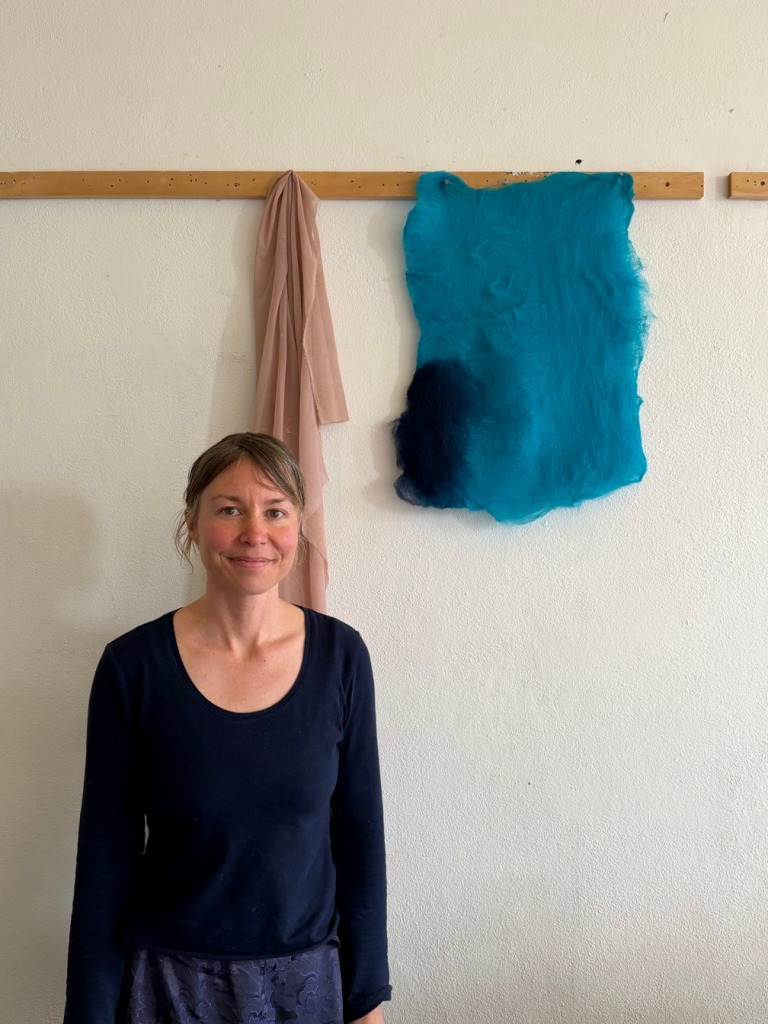
In a cold Melbourne warehouse during COVID-era lockdowns, Clare Wohlnick began making one of her first large felt works. A painter she was working for had offered her the industrial space, and she filled it with soft wool. Today, she is continuing this work of large-scale felted pieces.
Clare has worked with wool on and off for around eight years. When shoulder pain prompted a break from the strenuous work of felting, she turned to oil painting, becoming absorbed in the shifting colours and textures of landscapes. She wanted to draw something out of what she saw, taking it beyond a literal depiction.
But the gum turpentine began to bother her, and she missed wool.
“I just love the tactility of it, the physicality, and I like the idea that the colour is inherent in the material,” she says.
In oil painting, Clare applies coloured paint to the surface of a canvas. With felting, the colour is held in the wool fibres, which she layers and works together to build the image itself.
Her starting points are often landscapes, but they can also be photographs taken on her phone: patches of sky, textures in walls or reflections in windows. She’s interested in how reflections can flatten objects into abstract arrangements of colour. During felting, netting placed over the wet wool produces a similar filtering effect, briefly transforming the surface beneath it.
Beauty emerges through these small acts of attention, but Clare is also thinking about what happens when a work feels complete. Recently, she visited an exhibition of works by Greek artist George Lappas in Athens, where quotes from the artist were displayed alongside the exhibition. Lappas described artworks as having their own character, an idea that resonated with something Clare recognises in making.
“You know when something is working because it’s looking back at you. You feel its presence.”
It’s a quality she’d like her own pieces to have: a sense of character that draws you in, with colour and texture offering something beyond an image to look at.
At WFAC, the studio’s high ceilings and generous space give Clare room to develop several works at once. Alongside vividly coloured wool, she’s experimenting with natural dyes, drawing on time spent at Threads of Life in Indonesia. One dye vat needs 30 days to cure.
Other parts of the process require less time, but more energy. Wet with soap and water, the wool must be rolled, pressed and bashed to bring the fibres together. Clare is even considering rolling a work down the WFAC hill, keeping the process running on “human power”.
For all the physical effort, handling the wool remains a pleasure.
“I think working with this material is very calming,” she says.
The work Clare has developed during her residency at WFAC will be shown at Fremantle Small Projects at the end of 2026.